
England & Wales · Last reviewed: 1st September 2026 · My Conveyancing Specialist
Yes — you can legally sell or buy a house without a FENSA certificate, but a missing FENSA certificate can slow the sale down, so it usually needs resolving before completion. A FENSA certificate proves that replacement windows or external doors — including double glazing — were installed to building regulations by a FENSA-registered installer. If it’s missing, the buyer’s solicitor will raise it, a mortgage lender may query it, and the sale can stall until it’s sorted. The good news: there are several straightforward fixes, and none of them needs to hold your move up for long.
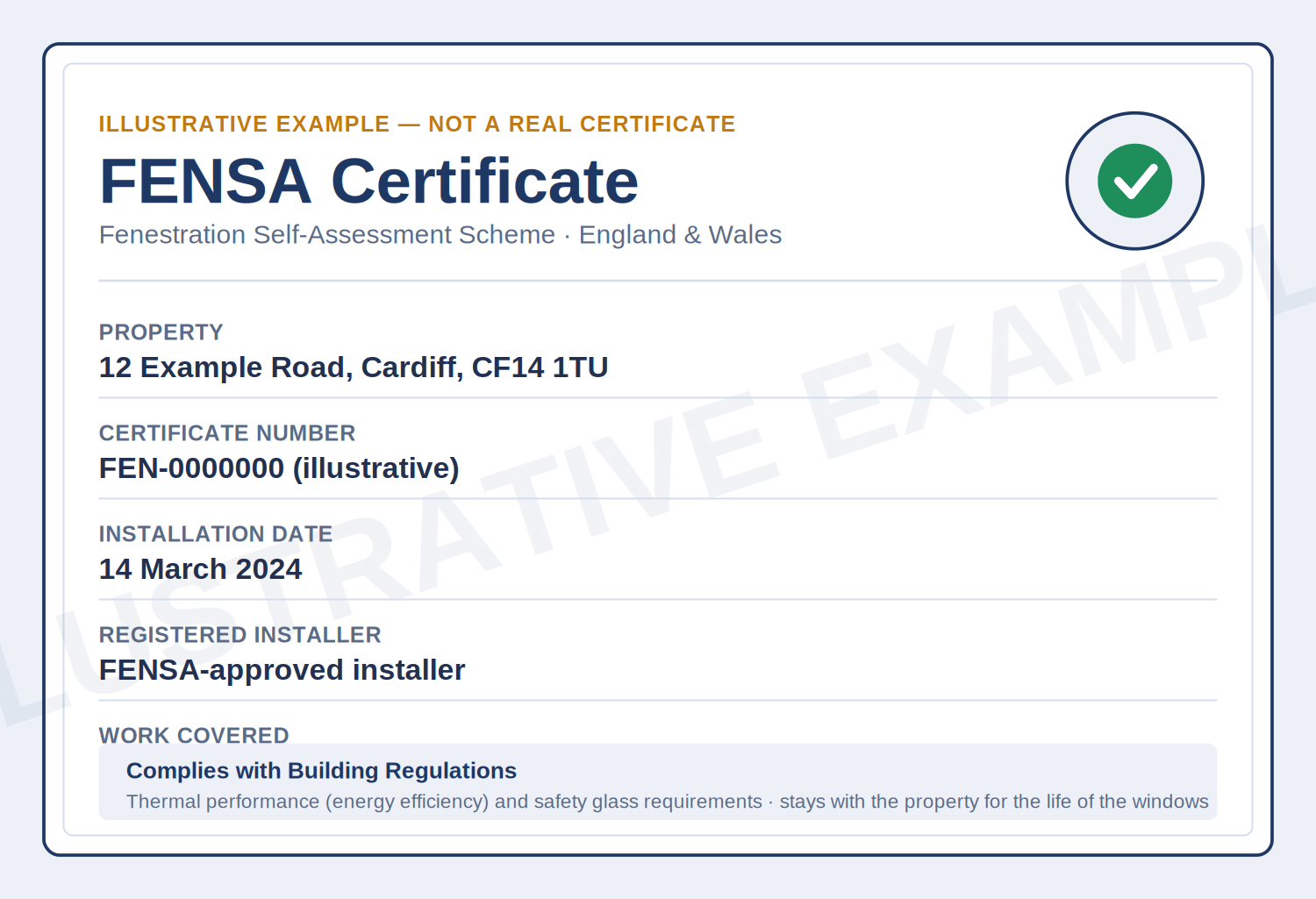
- It is not illegal to sell or buy a house without a FENSA certificate, but it can cause delays and worry lenders and buyers.
- A FENSA certificate is only needed for replacement windows, doors or roof windows fitted since 1 April 2002 in England and Wales. Older installations don’t need one.
- Your options if it’s missing: order a replacement, find a building control compliance certificate, get a retrospective (regularisation) certificate, or take out indemnity insurance.
- Indemnity insurance is the quickest, cheapest fix but doesn’t make the work compliant — and it’s void if you’ve already contacted the local council.
- Important update: a council can require non-compliant work to be altered or removed for up to 10 years after completion (previously 12 months) — in England since 1 October 2023, and in Wales since 1 July 2026.
What is a FENSA certificate?
FENSA stands for the Fenestration Self-Assessment Scheme. A FENSA certificate proves that replacement windows and external doors — most commonly double glazing — were installed in line with UK building regulations by a registered installer who is approved to self-certify their own work.
You need building regulations sign-off for replacement windows, external doors, roof windows and roof lights fitted since 1 April 2002 in England and Wales. That compliance can be shown by:
- a FENSA certificate, or
- a certificate from another Competent Person Scheme such as CERTASS or TrustMark, or
- a building regulations compliance certificate (completion or regularisation) from the local authority.
New windows fitted before April 2002, or as part of a new build signed off under its own building control, don’t need a FENSA certificate.
Related: What are conveyancing searches and enquiries?
What your FENSA certificate covers
A FENSA certificate confirms that the window and door installations:
- comply with building regulations at the time they were fitted;
- meet thermal performance standards for energy efficiency (the required U-values);
- use appropriate safety glass — usually toughened glass or laminated glass — in critical locations;
- were carried out by a FENSA-registered installer and registered with the local council.
It does not cover the internal condition of the glazing, faults that develop later, or any work outside the original installation.
Do you legally need a FENSA certificate to sell a house?
No. It is not illegal to sell — or buy — a house without a FENSA certificate. What the law actually requires is that the work itself complied with building regulations. The FENSA certificate is simply the usual proof of that.
The catch is that liability for non-compliant work rests with the current owner, regardless of who installed the windows. So a buyer inherits the problem — which is exactly why their solicitor will want it resolved before completion.
Why a missing FENSA certificate causes problems
During the conveyancing process, the buyer’s legal enquiries will check that any replacement windows and doors are certified. If nothing turns up:
- the buyer’s solicitor raises it as an enquiry and asks the seller to resolve it;
- a mortgage lender may be reluctant to lend, or may insist on indemnity insurance, until it’s dealt with;
- the buyer may worry the work is non-compliant or unsafe;
- the sale can be delayed, or occasionally fall through, while a fix is arranged.
First, check whether you even need one
Before doing anything else, confirm a FENSA certificate is actually required:
- When were the windows installed? If before 1 April 2002, no FENSA certificate is needed.
- Were they replacements? FENSA covers replacement windows, doors, roof windows and roof lights — not original ones signed off with the building.
- Is there another certificate? CERTASS, TrustMark, another Competent Person Scheme, or a local authority building control certificate all do the same job.
If the work predates April 2002 or is already certified another way, there may be nothing to fix.
Your options if there is no FENSA certificate
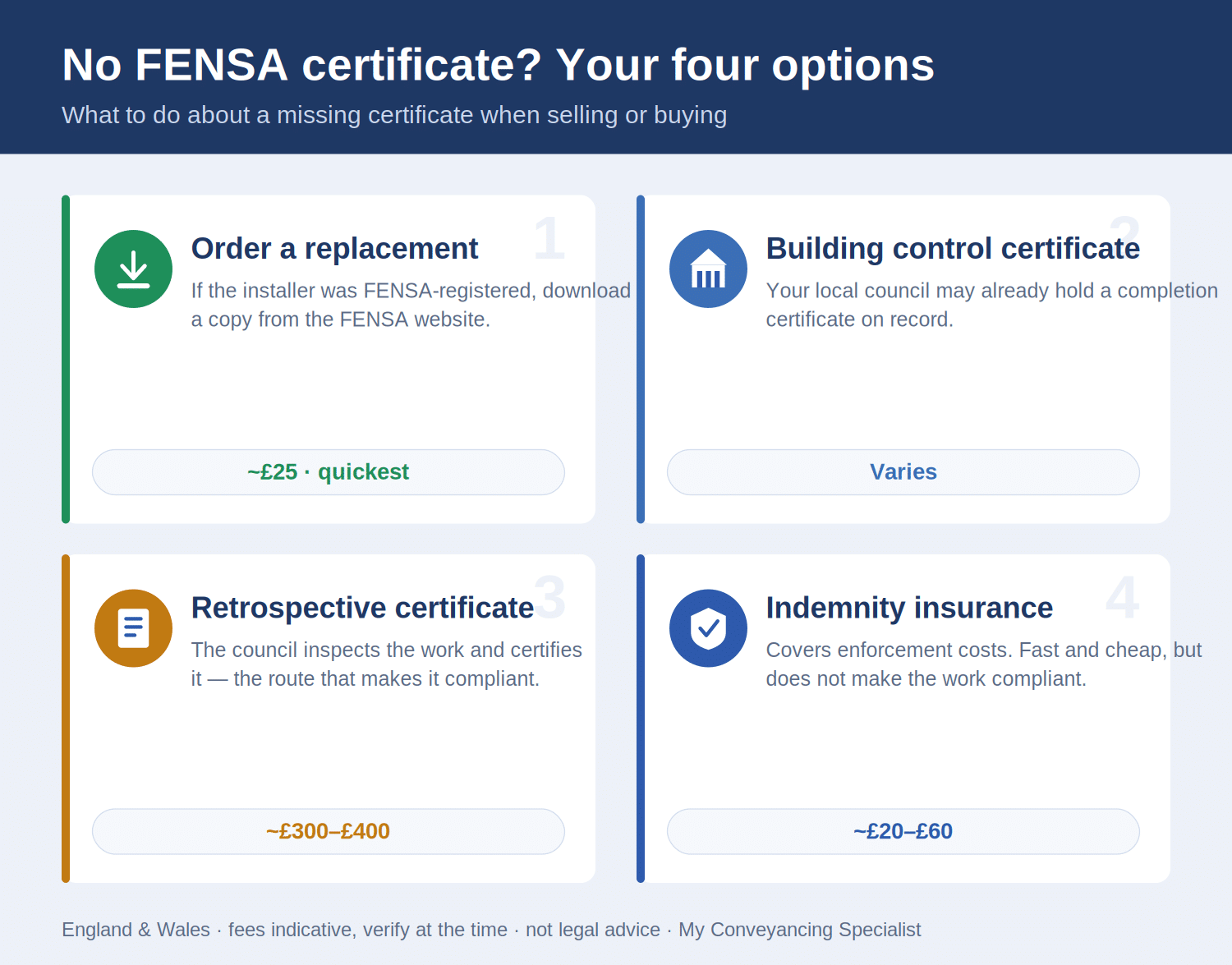
If a FENSA certificate is genuinely missing, there are four routes — as a seller or a buyer:
1. Order a replacement FENSA certificate. If the installer was FENSA-registered, the installation is on the FENSA database. You can search by house number and postcode on the FENSA website and order a replacement copy for a small fee (around £25 — verify current price). This is the easiest fix, so always check here first.
2. Check for a building control compliance certificate. Even without FENSA, the local council may hold a completion certificate if building control was notified at the time. Your conveyancer can request this as part of the process.
3. Apply for a retrospective (regularisation) certificate. If the work was never certified, you can apply to the local authority for a Retrospective Building Regulation Compliance Certificate. A building control officer inspects the windows against the regulations that applied when they were fitted, and issues a compliance certificate if they pass. This is the route that actually makes the position compliant — but it costs a few hundred pounds (commonly around £300–£400 — verify), takes time, and only works if the installation meets the standard. If it doesn’t, remedial work may be needed.
4. Take out building regulations indemnity insurance. A one-off indemnity insurance policy (often £20–£60 — verify) covers the cost of any enforcement action by the council. It’s the quickest and cheapest option and is frequently used to keep a sale moving. But note its limits:
- it does not make the work compliant — it only covers enforcement costs;
- insurers usually require the work to be at least around 12 months old before they’ll offer cover;
- it is void if you (or your solicitor) have already contacted the local council about the windows — so decide between indemnity and a retrospective certificate before approaching building control, not after;
- it won’t help if you later need to alter or extend the property in a way that brings the council in.
Related: How indemnity insurance works in conveyancing · Buying a house without building regulations approval
How to get a FENSA certificate
There are two ways to get a FENSA certificate:
- At the time of installation. Use a FENSA-registered installer for your replacement windows or doors, and they will register the job and issue your FENSA certificate — usually within a few weeks of the work.
- A replacement copy for existing work. If a certificate was issued but lost, order a duplicate from the FENSA website using your house number and postcode.
If your windows were not fitted by a FENSA-registered installer, you can’t get a FENSA certificate retrospectively — you would instead use a building control compliance certificate or indemnity insurance, as above.
How long does a FENSA certificate last?
A FENSA certificate does not expire. It lasts for the lifetime of the windows and doors it covers, and it stays with the property, not the owner — so when you sell, you pass it on to the buyer. There is no need to renew it after 10 years or any other period; you only need a new FENSA certificate if you replace the windows or doors again.
Important: the enforcement rules have changed
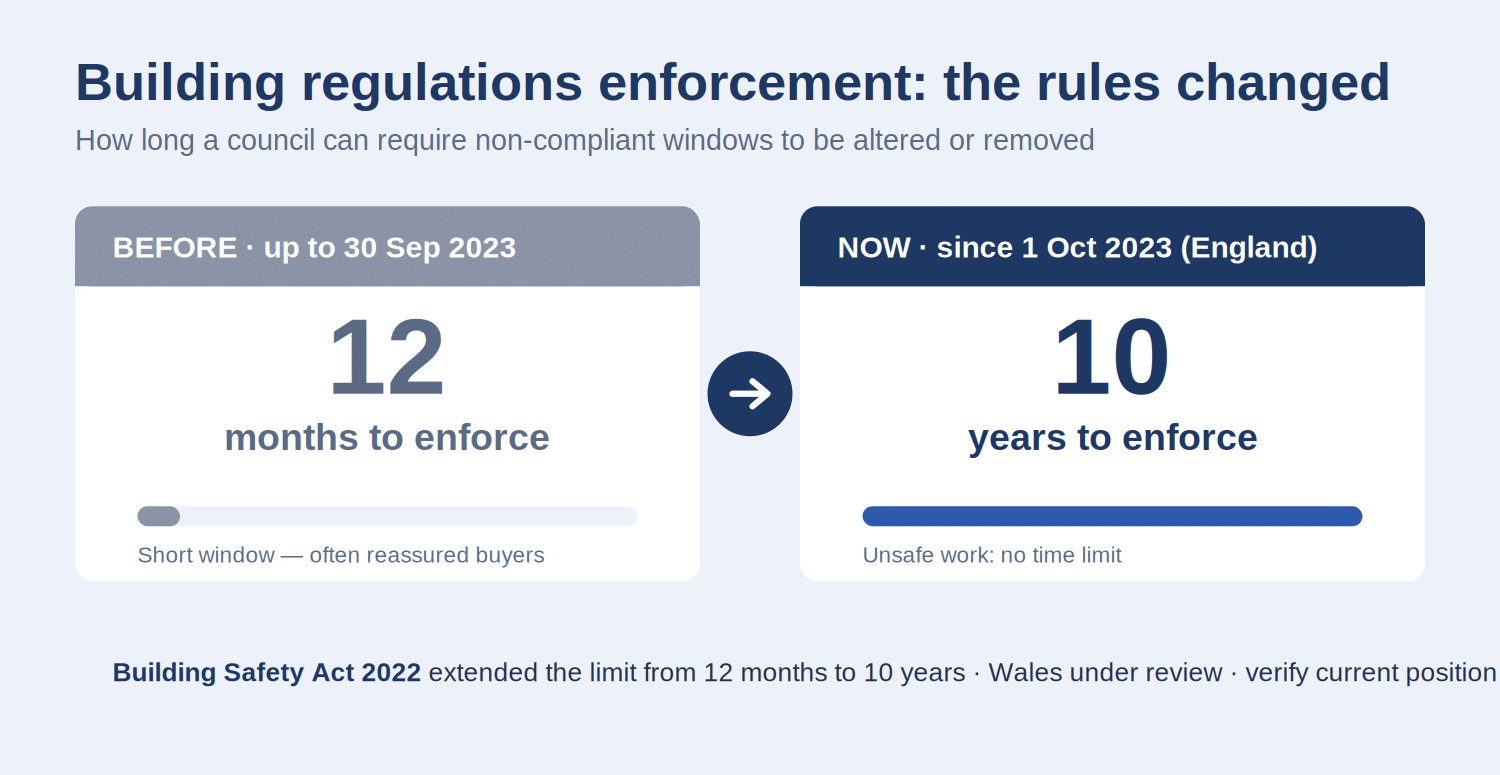
Many older guides say a council can only require non-compliant work to be removed or altered within 12 months of completion. That is no longer correct.
The Building Safety Act 2022 extended that enforcement window from 12 months to 10 years from completion of the work — in England from 1 October 2023, and in Wales from 1 July 2026. The change isn’t retrospective, so work completed before those dates keeps the previous 12-month limit. Separately, prosecution for breaching building regulations now carries an unlimited fine and up to two years’ imprisonment, and genuinely unsafe work can be enforced against at any time.
Two practical points follow:
- The old reassurance that “the council can’t do anything after a year” no longer holds for recent work — which is partly why buyers and lenders now take missing certificates more seriously.
- The insurers’ “work must be 12 months old” rule is a separate underwriting condition, not the legal enforcement limit. Don’t confuse the two.
Indemnity insurance vs a retrospective certificate: which is right?
| Indemnity insurance | Retrospective (regularisation) certificate | |
|---|---|---|
| Typical cost | Low (often £20–£60) | Higher (often £300–£400 + any remedial work) |
| Speed | Fast — often same day | Slower — inspection and processing time |
| Makes the work compliant? | No — only covers enforcement costs | Yes — confirms compliance |
| Best when | Work is older, low risk, sale needs to move quickly | You want it properly resolved, or plan to extend/alter later |
| Key catch | Void if the local council has been contacted | Only issued if the work actually meets the standard |
Figures are indicative as at September 2026 — confirm current costs.
Advice for sellers
- Get ahead of it. Locate or order a replacement FENSA certificate before you list — it’s far quicker than sorting it mid-sale.
- Don’t contact the council about the windows if indemnity insurance is likely to be your route, as that voids cover.
- Disclose accurately. The TA6 Property Information Form asks whether windows or doors have been replaced since 2002 and whether you have the relevant certificates. Answer honestly — non-disclosure can come back on you.
Related: What documents do I need to sell my house?
Advice for buyers
- Raise it through your solicitor and decide what remedy you’ll accept — replacement certificate, regularisation, or indemnity insurance.
- Check your lender’s requirements, as some insist on certification or indemnity before releasing funds.
- Indemnity is often arranged at the seller’s cost as part of the negotiation.
- Think ahead: if you plan to extend or alter the property, an indemnity policy may be little use, because involving the council can void it — a retrospective certificate may be the better long-term fix.
What about Scotland and Northern Ireland?
FENSA operates in England and Wales. Scotland has its own building standards system, where replacement windows are covered by a completion certificate from the local authority rather than FENSA. Northern Ireland also has separate arrangements. If you’re buying or selling there, take local advice.
Cost and time at a glance
| Option | Typical cost (verify) | Typical time |
|---|---|---|
| Replacement FENSA certificate | ~£25 | Quick, if FENSA-registered |
| Building control certificate copy | Varies | Depends on the council |
| Retrospective / regularisation certificate | ~£300–£400 + remedial work | Weeks; needs an inspection |
| Building regulations indemnity insurance | ~£20–£60 (one-off) | Often same day |
Frequently asked questions
Can you sell a house without a FENSA certificate? Yes. It is not illegal, but a missing FENSA certificate can delay the sale and concern lenders and buyers, so it’s usually resolved before completion — often with a replacement certificate, a retrospective certificate, or indemnity insurance.
Is it illegal to have windows without a FENSA certificate? No. What the law requires is that the work complied with building regulations; the certificate is the usual proof. If it’s missing, you can still show compliance another way or protect against enforcement with indemnity insurance.
Do I need a FENSA certificate for windows fitted before 2002? No. Building regulations began requiring certification for replacement windows and doors on 1 April 2002 in England and Wales. Anything fitted before then doesn’t need a FENSA certificate.
How do I get a replacement FENSA certificate? If the installer was FENSA-registered, search by house number and postcode on the FENSA website and order a replacement copy for a small fee (around £25). Always check here first.
Can you get a retrospective FENSA certificate? Not from FENSA itself — it only certifies work done by its registered installers at the time. Instead you apply to the local authority for a retrospective building regulation (regularisation) certificate, or take out indemnity insurance.
Is a FENSA certificate valid after 10 years — does it expire? No. A FENSA certificate does not expire and does not need renewing. It lasts for the lifetime of the windows and doors and stays with the property. You only need a new one if you replace the windows or doors again.
Can I get a FENSA certificate if I fit my own windows? No. FENSA certificates are issued by FENSA-registered installer companies that self-certify their work. If you fit your own windows, or use an installer who isn’t registered, you’ll need building control sign-off (a compliance or regularisation certificate) or indemnity insurance instead.
What if my window installer wasn’t FENSA registered? Check whether they belonged to another Competent Person Scheme such as CERTASS or TrustMark, as those issue equivalent certificates. If not, the work should have had building control sign-off — if it didn’t, you’re into the missing-certificate options above.
Can I install windows without FENSA? Yes. You can use an installer registered with another Competent Person Scheme, or have the work signed off by local authority building control instead of FENSA. What matters is proof of building regulations compliance, not FENSA specifically.
What is FENSA indemnity insurance and how much does it cost? It’s a one-off building regulations indemnity policy that covers the cost of any council enforcement action over uncertified windows. It’s usually cheap (often £20–£60) but doesn’t make the work compliant and is void if the local council has already been contacted.
How long can a council take action over uncertified windows? Up to 10 years after completion — in England since 1 October 2023, and in Wales since 1 July 2026 (previously 12 months in both) — and unsafe work can be enforced against at any time.
Key takeaways
- You can legally sell or buy without a FENSA certificate, but it’s best resolved before completion.
- A FENSA certificate is only needed for replacement windows, doors and roof windows fitted since 1 April 2002.
- Fixes: replacement certificate, building control compliance certificate, retrospective (regularisation) certificate, or indemnity insurance.
- A FENSA certificate doesn’t expire and stays with the property.
- Enforcement now runs for up to 10 years — in England since 1 October 2023 and in Wales since 1 July 2026, not the old 12 months — so missing certificates are taken more seriously than they used to be.
This article is general information about the position in England and Wales as at September 2026 and is not legal advice. Rules, fees and lender requirements change. A qualified conveyancer can advise on the best route for your particular sale or purchase.
Buying or selling and worried about a missing FENSA certificate? My Conveyancing Specialist deals with certification enquiries and indemnity insurance every day and can keep your move on track. Get your fixed-fee conveyancing quote today.
Get an Instant Quote >>